
 shockerhitch.com
Shocker Hitch Air
In Dan's words: “We've towed with this for approximately 18k miles with great results.”
Hitch & Tow · Reviewed
A pivot-point hitch with an adjustable air cylinder in place of rigid weight-distribution bars. ~18,000 miles towed, no conventional WD hitch needed.
shockerhitch.com
In Dan's words: “We've towed with this for approximately 18k miles with great results.”
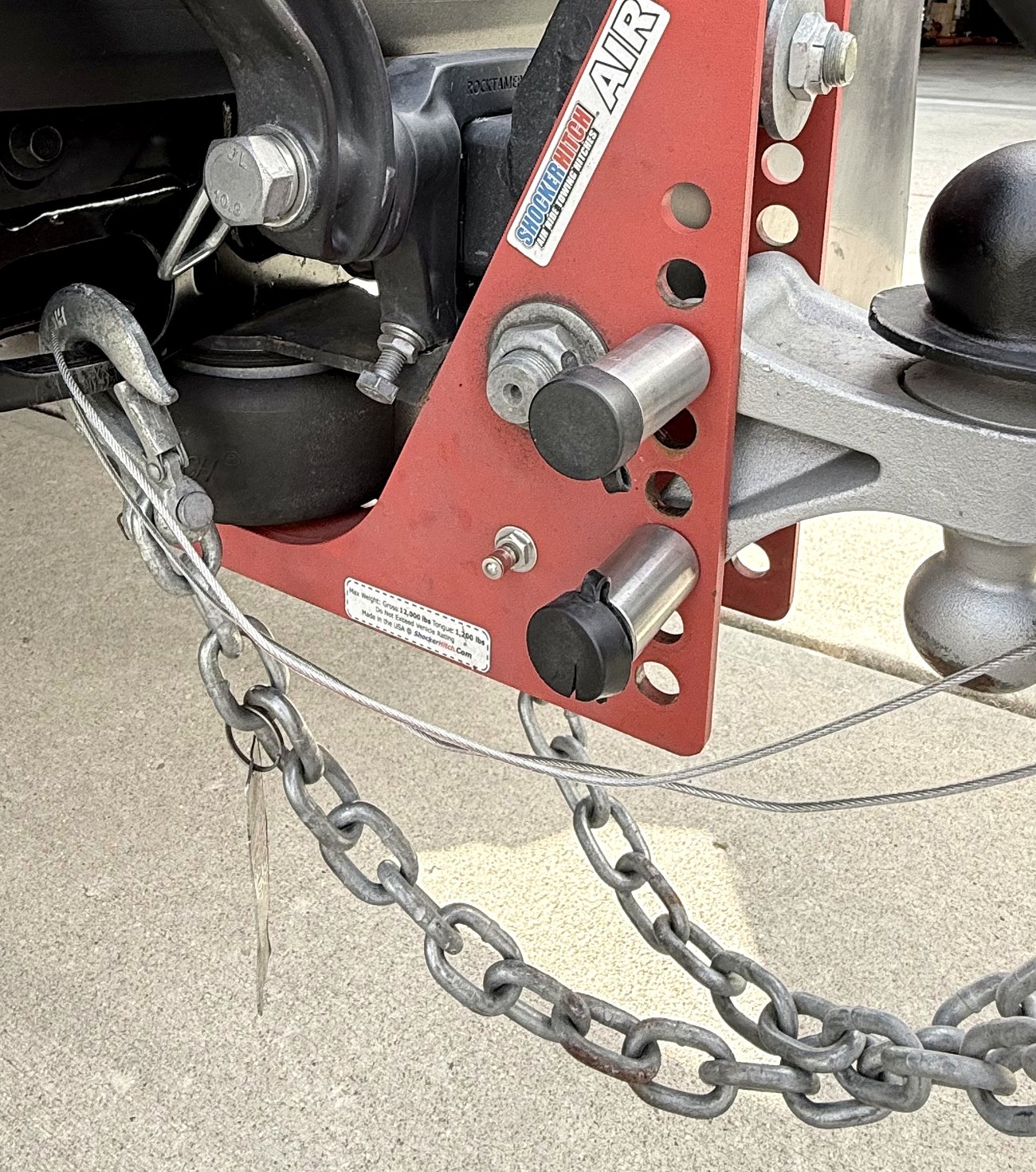
The spec plate calls out a 12,000 lb gross / 1,200 lb tongue rating. Chains crossed, breakaway cable clipped to the truck, ready to go.
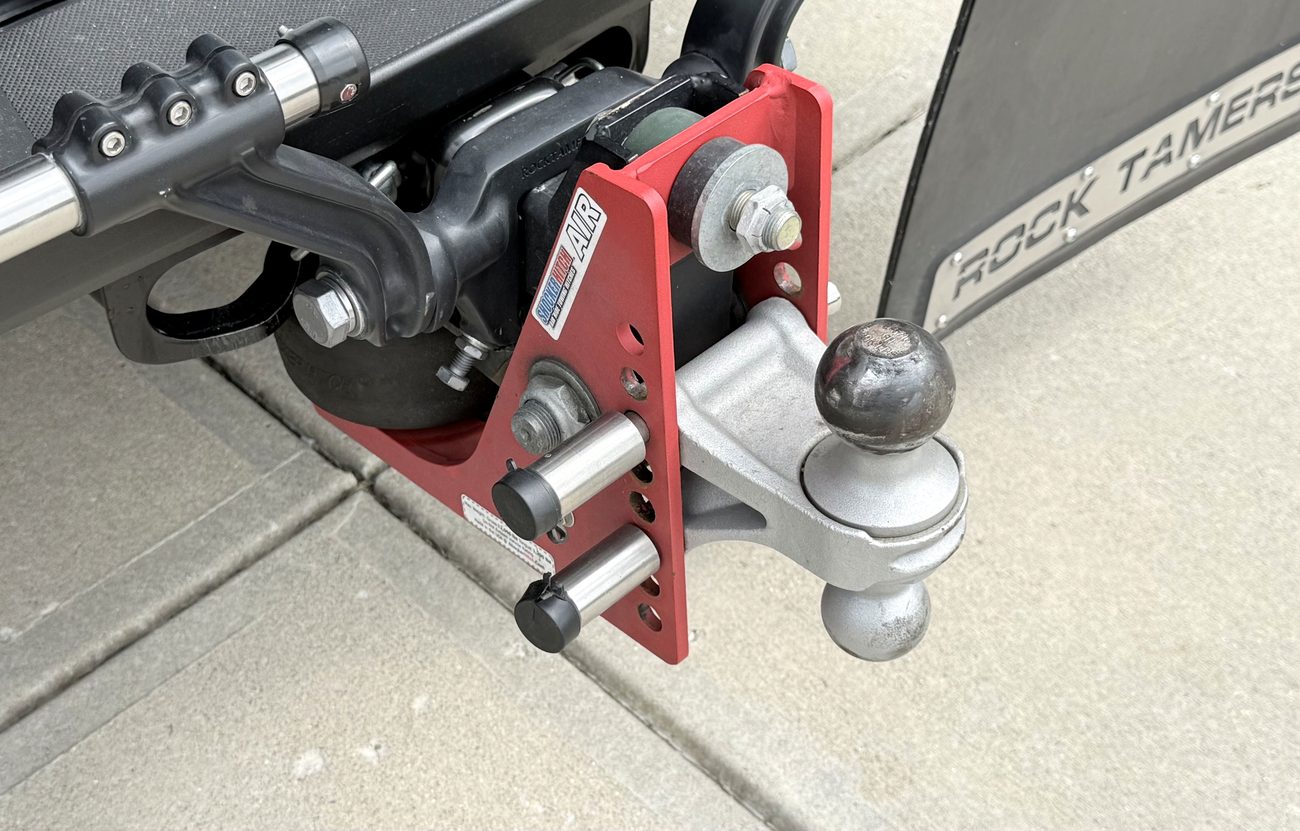
A standard hitch connects the truck and trailer through a pair of rigid steel bars: strong, dependable, and just as happy to transmit every pothole and expansion joint straight into the cab as they are to keep the trailer level. A Shocker Hitch Air does the same basic job (keeping the load level, keeping the trailer's nose from porpoising) through a pivot point and an air cylinder instead. The connection flexes instead of fighting back.
That let us retire a conventional weight-distribution hitch entirely. In its place: the Shocker at the coupler, and a set of LogicIQ air bags with an onboard compressor doing the leveling work on the truck's rear axle. Same job, done with air pressure instead of leverage bars.
No spring bars to wrestle onto the hitch head at every stop, no chains to tension just right. Once the trailer's coupled up, we run a portable air compressor to air the cylinder up to whatever the load calls for, and that's the whole routine.
The bigger difference shows up on the road. A rigid WD hitch transmits every bit of the trailer's push and pull straight through the frame; this one absorbs it. The result is a much smoother drive, without the constant back-and-forth jerk of the trailer working against the truck over rough pavement. On a long driving day, that adds up to noticeably less fatigue behind the wheel.
It isn't without trade-offs. The hitch itself is heavy, and genuinely cumbersome to mount to the truck on your own. Depending on how it's configured, it isn't cheap either. For what it gives back, a noticeably smoother ride, we think it's a worthwhile investment, but it's not a casual upgrade.
“We've towed with this for approximately 18k miles with great results.”
That's Dan's whole review in one sentence, delivered the way a pilot signs off a squawk sheet: no defects found, next flight. It's easy to call a hitch a solved problem the day you buy it. The truth only shows up over enough miles and enough kinds of road to actually test it.
Those miles have run through everything from Newfoundland's coastal crosswinds and rugged roads to the elevation changes of the Western Loop: up through Yellowstone and Grand Teton country, then down into the switchbacks around Monument Valley. Different grades, different wind, different pavement, same hitch, same result. Full write-ups of both trips are coming to the Highways page; the short version is that the hitch has never been the thing we've had to think about. It just does its job and lets us think about the road instead.
There's a practical side to the smoother ride, too. Every jolt that doesn't reach the truck also doesn't reach the trailer, which means less wear on cabinet latches, less strain on mounting hardware, and a lot less to clean up at the next stop. Any Airstream owner knows the feeling of opening the door after a rough tow to find it looks like an F5 tornado came through. We open ours to find everything right where we left it.
That's the whole point of good gear on a rig like this: it should be forgettable, in the best sense. Eighteen thousand miles in, the Shocker Hitch Air has earned exactly that, and we'd buy it again.